The temperature equivalents apply to large
2.5" pyrometric cones when heated at the indicated heating rate in
an air atmosphere. Small cones in the automatic shut-off have
approximately the same temperature equivalent.
When looking into the observation holes all objects that are near
the same temperature will be near the same color. Brighter
appearing objects are hotter than darker ones.
This table is for general information. Consult the manufacturer's
instructions for the correct cone number to use.
Why Use Pyrometric Cones
Cones have been used in firing ceramics for more than
100 years. They are useful because they can determine when a
firing is complete, or if the kiln was provided enough heat, or if
there is a temperature difference in the kiln, or if a problem
occurred during the firing.
What is a Cone?
Cones are slender pyramids made from about 100
carefully controlled compositions. They bend in a repeatable
manner over a relatively small temperature range (less than 50°F).
The final bending position is a measure of the amount of heat
absorbed. We refer to one cone number as being hotter or cooler
than another. The coolest cone number is O22 and the hottest is
42. The first cones were numbered from 1 to 20. When cooler cones
were developed, an 'O' was placed before the number. So cones
cooler than Cone 1 increase from O1 to O2, etc. to O22.
Cone Bending
Both temperature and time and sometimes atmosphere affect the
final bending position of a cone. Temperature is the predominant
variable. We refer to the temperature as an equivalent
temperature, since actual firing conditions may vary somewhat from
those in which the cones were originally standardized. Using
charts available from Orton, an equivalent temperature can be
determined by measuring the final bending position of the Cone, if
the heating rate is known. Orton Self-Supporting Cones duplicate
their bending behavior with a standard deviation of 2.4 angular
degrees or less than + 2°C.
How are Cones Used?
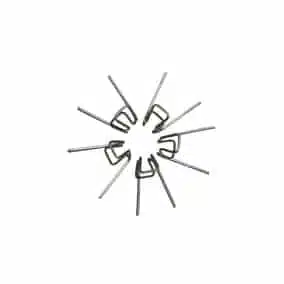
Cones are used as witness cones located on a kiln shelf near the
ware or in a kiln shut off device (e.g. Kiln-Sitter®). The cone
bends when glass forms and it becomes soft. The composition of the
cone and the amount of heat determine when and how much glass if
formed. It is important to note that it is the weight of the
sensing rod that causes the cone (or bar) in a Kiln-Sitter® to
bend. Changes in weight affect the bending of the cone. A witness
cone bends because of gravity acting on it. Therefore, mounting
height and angle is important. The higher the cone or the more it
leans over at the start, the more gravity affects bending, causing
early bending. It is for this reason Orton developed
Self-supporting witness cones some 20 years ago, where mounting
height and angle is fixed. It typically takes 15 to 25 minutes for
a cone to bend, depending upon the cone number. The cone bends
slowly at first but once it reaches the halfway point, it bends
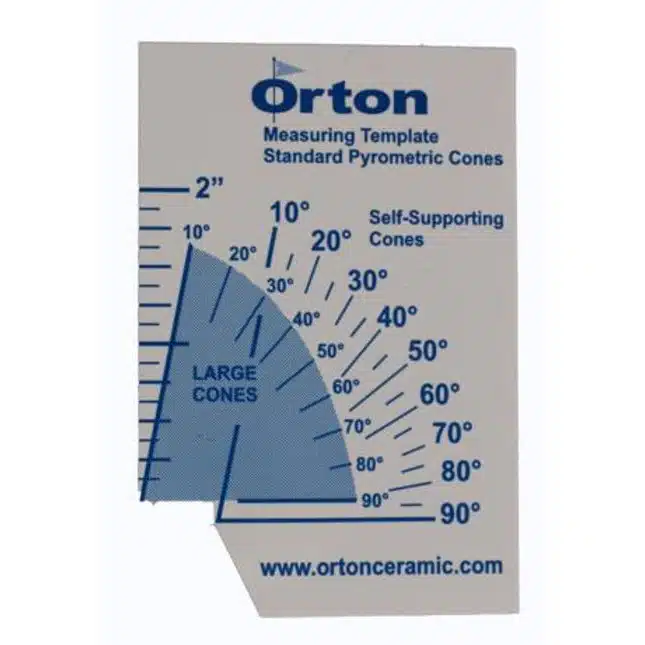
quickly. When the cone tip reaches a point level with the base, it
is considered properly fired; however, the difference between a
cone touching the shelf and a cone at the 4 o'clock position is
small and rarely affects the fired results.
Why use Cones?
Firing ceramics is much like baking, except temperatures are
higher. Ceramics can be fired over a range of temperatures. Some
products have a wide firing range while others have a narrow
range. Firing to a slightly lower temperature requires the ware to
be held for a longer time, just as it would be done if one were
baking a turkey. This is because it takes time for the ware to
absorb all of the heat needed to properly "cook" the piece. We
refer to this absorption of heat as 'heatwork'. When the amount of
heatwork for two firings is the same, the pieces will look
identical, even if one is fired to a higher temperature for a
short time and another is fired at a lower temperature for a
longer time. Since cones measure heatwork, all manufacturers
recommend the cone number to which their product should be fired.
Three Cone System
Many products used today, such as porcelain and lead-free glazes,
need to be fired within a 2-cone range. The 3-cone system can be
used to determine temperature uniformity and to check the
performance of the Kiln-Sitter® or electronic controller. The
3-cone system consists of three consecutively numbered cones:
• Firing Cone - cone recommended by manufacturer of glaze, slip,
etc.
• Guide Cone - one cone number cooler than firing cone.
• Guard Cone - one cone number hotter than firing cone.
For example: Cones O17, O18, O19 or Cones 5, 6, 7.
Cones Help Evaluate Kilns
Most kilns have temperature differences from top to bottom. The
amount of difference depends on the design of the kiln, age of the
heating elements, load distribution in the kiln, and the cone
number to which the kiln is fired. Usually, kilns have a greater
temperature difference at cooler cone numbers. Use cones on the
lower, middle and top shelves to determine how much difference
exists during firing. It's best to do this for each type of firing
you do - i.e. decal, bisque/glaze, porcelain/stoneware. After
firing, observe the 3 cones. If, on the bottom shelf, the Guide
cone has only bent half way, then ware is fired one and half cones
lower. A Guard cone on the top shelf bent halfway indicates that
ware is a half cone hotter and a 2-cone difference exists between
the top and bottom of the kiln. If you find a difference, make
changes in the way the kiln is loaded and fired to reduce this
difference. Adding downdraft venting will also even out
temperatures. The kiln can also be upgraded to Orton's UniTemp™
controller, which keeps the kiln uniform in temperature (see Kiln
Controllers).
Checking Kiln Sitter® Performance
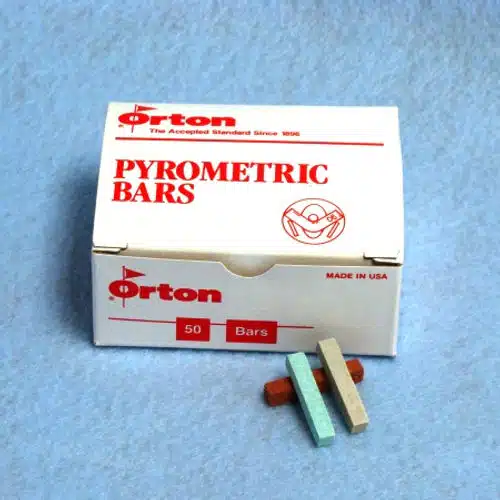
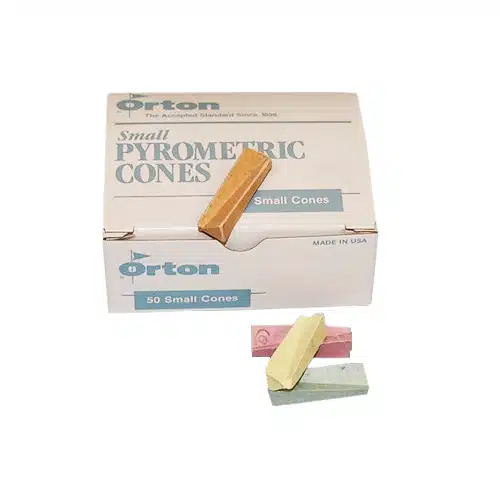
The Kiln Sitter® shuts off the kiln when a small cone (or bar)
placed under the sensing rod receives enough heat for it to fully
bend. Bending is caused by the weight of the sensing rod. Because
the cone in the Kiln Sitter® is located at the kiln wall (closer
to the heating elements), it frequently receives more heat than
witness cones, causing the kiln to shut off early. Using the next
hotter cone/bar may be necessary. Use the 3-cone system on a shelf
near the Kiln Sitter® to determine if a difference exists between
the shelf and Kiln Sitter® cones.
Checking Controller Performance
Electronic controllers allow firing to a temperature (and even a
cone number). The controller uses a temperature reading measured
by one or more thermocouple(s) placed through the refractory wall
of the kiln. A Self-supporting witness cone will check whether the
controller is firing accurately. Place the cone in a location near
the thermocouple. After the firing, determine if the Firing Cone
has bent properly. There should be no more than a half cone
difference. Orton encourages the use of electronic controllers;
however, we strongly recommend the use of at least one witness
cone for every firing to assure that the kiln really did fire to
the right cone number. As mentioned earlier, bodies, glazes and
decoration products are all formulated to be fired to a cone
number, bent to the 90° (6 o'clock) position. Controllers depend
upon accurate measurement of temperature and proper programming to
fire properly. Most controllers use a Type K thermocouple, which
may not give an accurate temperature and which will change after
being used. It is not unusual for a Type K thermocouple to have an
error of more than 25°F when fired to Cone 6 repeatedly. This is
more than a full cone. By using witness cones, you can determine
whether the firing was to the right cone number.
Self-supporting Witness Cones
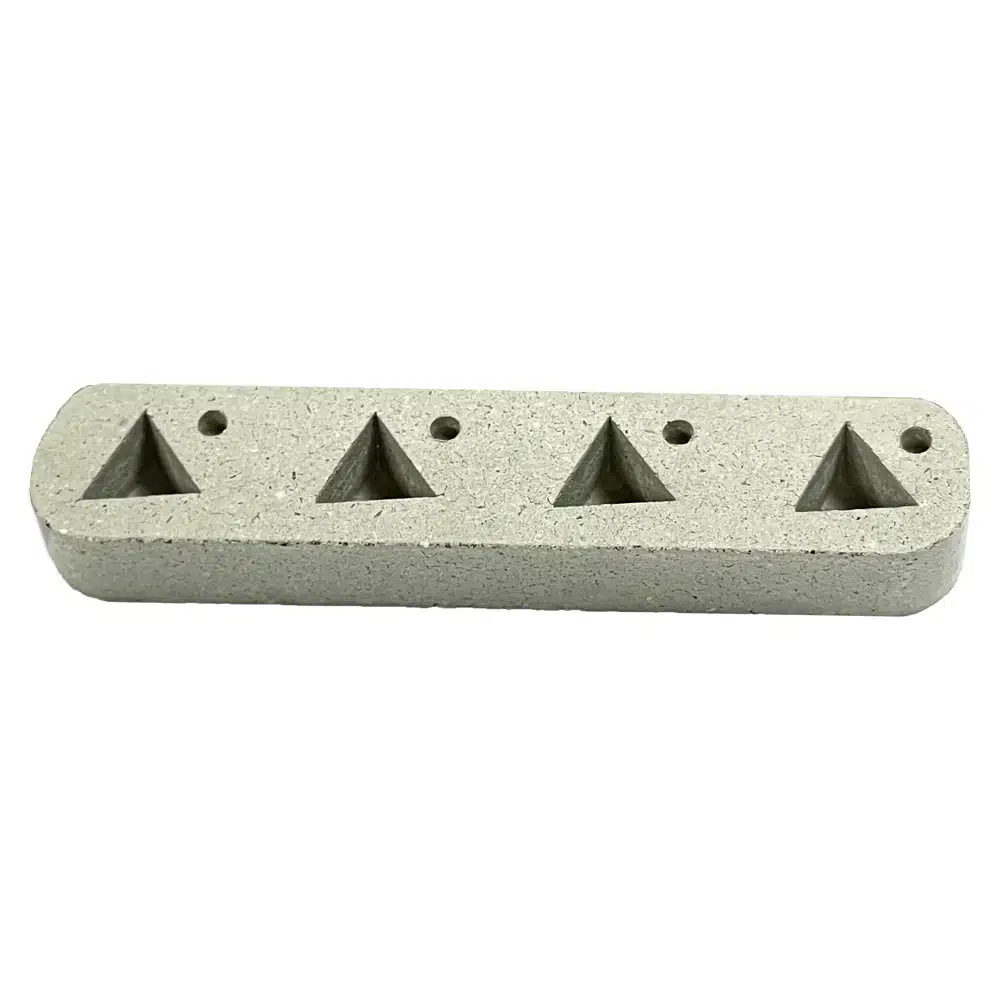
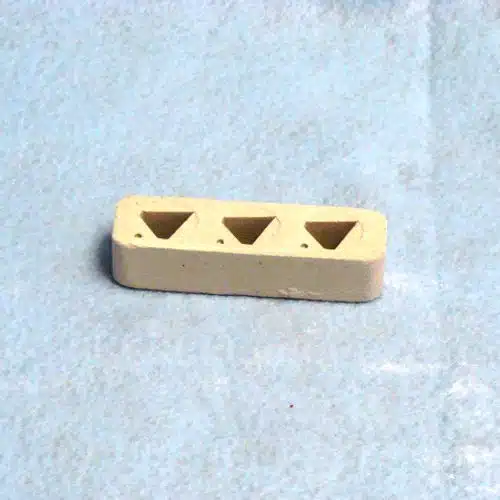
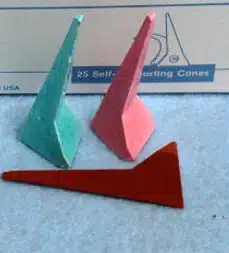
Orton recommends Self-supporting witness cones because they are
easier to use and less subject to bending variation. Many people
use witness cones every firing and the 3-cone system periodically
to check for changes in the kiln. Cones are saved to compare
different firings. When more than a half cone difference occurs,
it usually indicates a problem exists. This gives you an
opportunity to fix the problem or change the way the kiln is being
fired to avoid future problems. Cones are the best way to
inexpensively monitor your kiln.